


Amenorrhea and Fertility: Understanding the Absence of Menstruation on the Path to Parenthood
Restoring the cycle: How specialized diagnostics and therapy at the Kinderwunschzentrum Dresden help you conceive even without a regular period.
A regular menstrual cycle is often seen as the primary sign of female fertility. When the period stays away entirely—a condition known as amenorrhea—it can trigger profound concern and a feeling of uncertainty. For those with an unfulfilled wish to have children, the absence of a period feels like a significant barrier to their goal.
However, amenorrhea fertility is a field where modern reproductive medicine achieves remarkable successes. The absence of menstruation is not a final verdict of infertility, but rather a signal from the body that the delicate hormonal balance has been disrupted. At Kinderwunschzentrum Dresden, we specialize in deciphering these signals.
This guide provides a deep dive into the types of amenorrhea, the underlying causes, and the specialized treatments available. Our goal is to understand why your period is absent and to open up a perspective for a successful pregnancy.
What is amenorrhea?
In medical terms, amenorrhea is defined as the absence of menstrual bleeding. It is not a disease in itself, but a symptom of an underlying physiological or hormonal condition. To determine the right approach for amenorrhea fertility, it is crucial to distinguish between its two forms.
Primary amenorrhea describes the absence of the first menstrual period by the age of 16 years in the presence of normal pubertal development, or by the age of 14 years if there are no signs of puberty. Secondary amenorrhea is defined as the cessation of a previously established period. Both forms require a specialized diagnostic approach to restore reproductive health.
At the Kinderwunschzentrum Dresden, we treat every patient with the sensitivity this topic requires. Whether you are dealing with a long-term absence of your period or a sudden change in your cycle, our experts are here to find the "why" and work toward a solution for your family planning.
Primary amenorrhea: Causes and possibilities
Primary amenorrhea is less common than the secondary form but is deeply linked to the fundamental development of the reproductive system. For those facing primary amenorrhea and a desire to have children, the diagnostic journey often starts with looking at anatomical and genetic foundations.
The causes can range from chromosomal variations, such as Turner Syndrome, to anatomical differences in the development of the uterus or ovaries. In some cases, a late onset of puberty due to constitutional factors or extreme physical stress is the reason.
Is a primary amenorrhea pregnancy possible? The answer depends heavily on the presence of functional ovaries and a uterus. Even if natural conception is a challenge, modern assisted reproduction offers paths to parenthood.
Secondary amenorrhea: The most common hormonal hurdle
Secondary amenorrhea is a frequent concern in fertility clinics. Often, the cycle stops because the body has decided that the current conditions are not ideal for a pregnancy. This is often a reversible state once the root cause is addressed.
Many women ask if they can get pregnant despite secondary amenorrhea. Since the absence of a period usually means an absence of ovulation (anovulation), natural conception is temporarily on hold. However, once the "switch" for ovulation is flipped back on through therapy, fertility often returns quickly.
Common triggers for secondary amenorrhea that we treat at the Kinderwunschzentrum Dresden include:
- Polycystic Ovary Syndrome (PCOS).
- Hyperprolactinemia (elevated prolactin levels).
- Thyroid dysfunction (hypo- or hyperthyroidism).
- Hypothalamic amenorrhea (often caused by high stress, low body weight, or excessive exercise).
- Premature Ovarian Insufficiency (POI).
Amenorrhea infertility: Why the cycle stops
The menstrual cycle is controlled by a complex feedback loop involving the brain (hypothalamus and pituitary gland) and the ovaries. If any part of this communication chain is broken, the cycle stalls. This leads to the connection between amenorrhea and infertility.
Without the rise and fall of hormones like FSH (Follicle-Stimulating Hormone) and LH (Luteinisizing Hormone), no egg matures and no uterine lining is prepared. This state of "reproductive hibernation" means that sperm cannot find an egg to fertilize.
At the Kinderwunschzentrum Dresden, our goal is to restart this communication. By identifying exactly where the hormonal signal is disrupted, targeted hormonal support can be used to restart the cycle, with the aim of overcoming infertility related to amenorrhea.
Can you get pregnant with amenorrhea? Realities and success rates
One of the most frequent questions we receive is: "Can you get pregnant with amenorrhea?" The answer is a clear and encouraging yes. While you cannot get pregnant while the period and ovulation are absent, the medical "restart" of the cycle is highly successful.
Statistically, hormonal anovulation is one of the most treatable causes of infertility. According to the German IVF Register (DIR), once ovulation is successfully induced, the chances of pregnancy per cycle are nearly as high as those of women with a naturally regular cycle.
Success largely depends on the underlying cause of amenorrhea.
- PCOS: Very good chances with controlled ovarian stimulation.
- Hypothalamic amenorrhea: Excellent prospects after lifestyle adjustments or hormonal treatment.
- Premature menopause: The prognosis is more challenging and requires specialized approaches.
It is important to remain realistic: The path to success involves patience and a tailored treatment plan. At the Kinderwunschzentrum Dresden, we monitor your progress closely to ensure that the hormonal stimulation is just enough to trigger a healthy ovulation without overstressing your body.
Diagnostics at the Kinderwunschzentrum Dresden
A successful therapy begins with precision. We don't just treat the symptom; we look for the source. Our diagnostic process for amenorrhea fertility includes:
- Detailed Patient History: Discussing lifestyle, stress levels, and history.
- Comprehensive Blood Panels: Checking all relevant hormones (FSH, LH, Estrogen, Progesterone, Testosterone, Prolactin, and Thyroid). If necessary, functional tests such as a GnRH test can be performed.
- Ultrasound: Assessing the ovaries for follicle count and the uterus for anatomical health.
- Genetic Testing: If primary amenorrhea or early menopause is suspected.
Treatment paths: Overcoming the absence of a period
The good news is that in most cases, pregnancy is possible even with secondary amenorrhea. Treatment is always tailored to the specific underlying cause.
Hormonal stimulation
If the brain does not send sufficient signals to the ovaries, medications such as gonadotropins can be used to support the cycle. These medications stimulate the growth of follicles and can trigger ovulation.
Treatment of underlying conditions
If a thyroid disorder or elevated prolactin levels are present, medical treatment alone can often help normalize the menstrual cycle.
In women with PCOS, dietary changes or treatment of insulin resistance can be effective.
Lifestyle adjustments
In cases of functional amenorrhea caused by stress or being underweight, the most important “treatment” is often reducing physical and emotional strain and achieving healthy weight gain. Once the body has sufficient energy reserves, the menstrual cycle often resumes spontaneously.
The emotional journey: Dealing with the "Missing Signal"
The absence of a period can feel like a loss of femininity or a broken promise of the body. We understand that this is not just a medical issue but a deeply personal one. The psychological pressure of "not even having a cycle" can be immense.
At the Kinderwunschzentrum Dresden, we offer a safe space to discuss these feelings. We believe that reducing the emotional burden is a vital part of medical success. Our team supports you with empathy, ensuring you feel like a partner in your treatment, not just a patient.
FAQ – Frequently Asked Questions about Amenorrhea and Fertility
Can I get pregnant naturally despite amenorrhea?
It is extremely rare because the absence of a period usually signifies that no ovulation is occurring..
Does amenorrhea mean I am in early menopause?
Not necessarily. While Premature Ovarian Insufficiency (POI) is one cause, most cases of secondary amenorrhea are related to reversible hormonal imbalances or lifestyle factors. A blood test checking your AMH (Anti-Müllerian Hormone) and FSH levels at the Kinderwunschzentrum Dresden can provide clarity.
How long does it take for the period to return after treatment?
This depends largely on the underlying cause. With hormonal stimulation, ovulation can often be induced within a few weeks.
In cases of functional amenorrhea caused by being underweight, it may take several months for the body to recover before the menstrual cycle returns.
Is primary amenorrhea pregnancy possible with IVF?
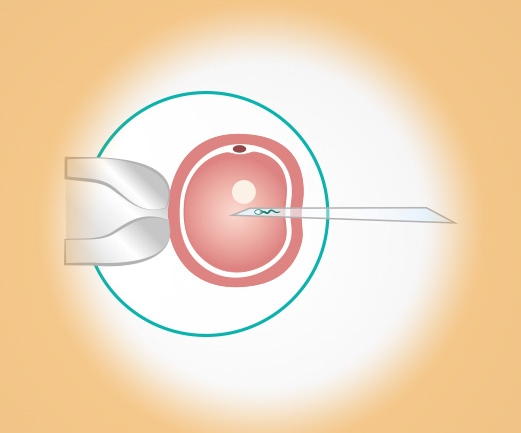
Yes. Depending on the underlying cause, IVF or ICSI can be used to achieve pregnancy. If the ovaries are functional but the "signaling" from the brain is missing, we can provide those signals through medication to retrieve eggs for fertilization.
Can chasteberry (Vitex agnus-castus) help with amenorrhea?
Chasteberry may be helpful in cases of mild cycle irregularities or slightly elevated prolactin levels.
However, in cases of true amenorrhea, it is usually not sufficient as a standalone treatment to achieve pregnancy.
Find your rhythm: Your appointment at the Kinderwunschzentrum Dresden
The absence of a period is a signal, not a dead end. At the Kinderwunschzentrum Dresden, we have the expertise to help you decode your body’s needs and restore your fertility.
Our team combines cutting-edge endocrinology with a heart-centered approach to care. We are dedicated to helping you move from the uncertainty of amenorrhea to the joy of a positive pregnancy test.
Take the first step toward restoring your cycle. Book your consultation – easily and confidentially via Doctolib.
Dresden Fertility Center
in the Wöhrl Plaza
Prager Str. 8a
01069 Dresden
Phone +49 351 501 400-0
Fax +49 351 501 400-28
Email:
Instagram Arrange your first appointment NEW: Video consultation! Downloads Impressions

Cryobank in the Kinderwunschzentrum Dresden
Prager Str. 8a
01069 Dresden
Tel. +49 351 50140019
E-Mail:
| Office hours | |
|---|---|
| Mon., Wed., Thu. | 08.00 – 19.00 Hrs |
| Tue. | 08.00 – 13.00 Hrs and 14.30 – 19.00 Hrs |
| Fri. | 08.00 – 14.00 Hrs |
Availability by telephone |
|
| Mon., Wed. | 08.00 – 13.00 Hrs and 14.30 – 18.00 Hrs |
| Tue., Thu., Fri. | 08.00 – 13.00 Hrs |
Blood sampling |
|
| Mon. - Thu. | 08.00 – 17.30 Hrs |
| Fri. | 08.00 – 13.30 Hrs |
On Tuesdays the clinic is closed from 13.00 to 14.30 Hrs! |
|






Service at the Fertility Center Dresden

To the planned child