


Social Freezing
Preserving your fertility through egg freezing – with advanced medical care and compassionate support at Kinderwunschzentrum Dresden.
Family planning does not always align with biology. Social Freezing allows women to freeze eggs at a younger age, improving the chances of a successful pregnancy later in life. For many, this option provides both reassurance and flexibility, but it also raises questions about process, costs, risks, and outcomes. At Kinderwunschzentrum Dresden, we offer clear guidance, evidence-based care, and empathetic support for women considering Social Freezing.
What is Social Freezing?
Definition
Social Freezing refers to the elective freezing of eggs for non-medical reasons – for example, when personal, career, or partnership circumstances mean that having children is planned later.
Difference from medical egg freezing
- Social Freezing: preventive, for personal or lifestyle reasons.
- Medical egg freezing: necessary if fertility is threatened by treatments like chemotherapy or ovarian surgery.
The process of egg freezing
Preparation
Initial steps include blood tests, hormone profiling, and ultrasound scans to assess ovarian reserve. A consultation ensures all medical and personal factors are considered.
Ovarian stimulation
For about 10–12 days, hormone medication is used to stimulate the ovaries to produce multiple mature eggs. Monitoring via ultrasound and blood work reduces risks and ensures optimal timing.
Egg retrieval
Mature eggs are collected during a short outpatient procedure under sedation, usually lasting 15–20 minutes.
Cryopreservation
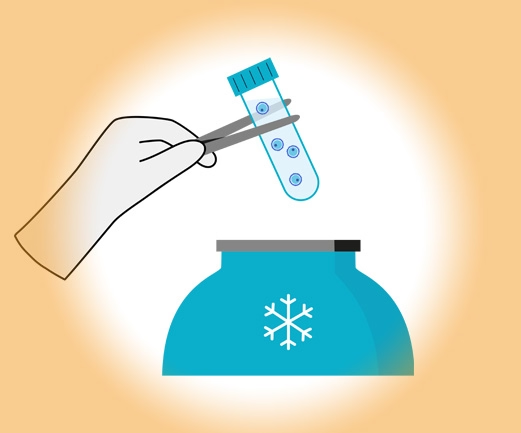
Eggs are frozen using vitrification – an ultra-rapid freezing technique at –196 °C in liquid nitrogen. This preserves them without time limits and with high survival rates upon thawing.
Social Freezing costs – What to Expect
Typical cost components include:
- hormone medication and monitoring
- egg retrieval procedure
- laboratory freezing process
- annual storage fees
At Kinderwunschzentrum Dresden, the cost of one cycle is usually 3,000–4,000 euros, plus an annual storage fee. A transparent cost plan is discussed in consultation.
Age and timing – when is Social Freezing most effective?
Best age for egg freezing
- Optimal results are achieved when eggs are frozen before the age of 35.
- With increasing age, egg quantity and quality naturally declines.
How many eggs should be frozen?
- Studies suggest that 30-40 frozen eggs provide a realistic chance of one live birth later.
- Depending on age and ovarian reserve, it may take one to three stimulation cycles to collect a sufficient number of eggs.
How long can eggs remain frozen?
- Technically, eggs can remain frozen indefinitely.
- Data show no decline in egg quality, even after many years in storage.
Success rates and survival of frozen eggs
- Survival after thawing: >90% with vitrification.
- Fertilisation rates: similar to fresh eggs.
- Pregnancy chances: strongly depend on age at freezing. Women who freeze eggs in their 20s or early 30s have significantly higher live birth rates than those freezing after 38.
Advantages and disadvantages of Social Freezing
Advantages
- Preserves fertility at a younger biological age.
- Provides flexibility in family planning.
- Reduces stress linked to the “biological clock.”
- A realistic option for future family planning
Disadvantages and limitations
- No guarantee of pregnancy later.
- Requires medical procedures and hormonal stimulation.
- Costs are usually self-paid.
- Risk of false security if performed too late.
Social Freezing at Kinderwunschklinik Dresden
Our approach:
- Personalised counseling – combining medical expertise with emotional support.
- State-of-the-art cryotechnology – ensuring safety and quality.
- Continuity of care – from decision-making to future use of the eggs.
FAQ – Common questions about Social Freezing
What does Social Freezing cost in total?
One cycle typically costs 3,000–4,000 euros, plus an annual storage fee.
Is there an age limit for Social Freezing?
There is no legal maximum age, but medically the procedure is most effective before 35 years of age. Younger age is associated with higher success rates.
How many eggs should be frozen for realistic chances?
Studies suggest that freezing around 30–40 eggs offers a realistic chance of having a child in the future. Depending on age and ovarian reserve, this may require more than one cycle.
How long can eggs remain frozen?
Eggs can remain frozen indefinitely. Research shows no reduction in survival or fertilisation potential over decades.
What are the risks of Social Freezing?
Risks include possible side effects from hormone stimulation and the chance that pregnancy may not occur despite frozen eggs. There are also minor risks associated with the egg retrieval procedure.
We’re here for you – get in touch!
Social Freezing offers a way to safeguard fertility and gain time for personal life planning. At Kinderwunschzentrum Dresden, we combine advanced medicine with empathetic support to help you make informed choices.
Book your consultation today – discreetly and conveniently via Doctolib.
Dresden Fertility Center
in the Wöhrl Plaza
Prager Str. 8a
01069 Dresden
Phone +49 351 501 400-0
Fax +49 351 501 400-28
Email:
Instagram Arrange your first appointment NEW: Video consultation! Downloads Impressions

Cryobank in the Kinderwunschzentrum Dresden
Prager Str. 8a
01069 Dresden
Tel. +49 351 50140019
E-Mail:
| Office hours | |
|---|---|
| Mon., Wed., Thu. | 08.00 – 19.00 Hrs |
| Tue. | 08.00 – 13.00 Hrs and 14.30 – 19.00 Hrs |
| Fri. | 08.00 – 14.00 Hrs |
Availability by telephone |
|
| Mon., Wed. | 08.00 – 13.00 Hrs and 14.30 – 18.00 Hrs |
| Tue., Thu., Fri. | 08.00 – 13.00 Hrs |
Blood sampling |
|
| Mon. - Thu. | 08.00 – 17.30 Hrs |
| Fri. | 08.00 – 13.30 Hrs |
On Tuesdays the clinic is closed from 13.00 to 14.30 Hrs! |
|







Service at the Fertility Center Dresden

To the planned child