

Blocked Fallopian Tubes: paths to pregnancy despite tubal factor infertility
Understanding tubal obstruction: How modern reproductive medicine at Kinderwunschzentrum Dresden helps you overcome anatomical barriers to conceive.
The fallopian tubes play a central role in natural conception. They are not merely transport routes but the very place where life begins through the meeting of egg and sperm. When a diagnosis of blocked fallopian tubes is made, it often comes as a shock to many couples, raising the urgent question: Is a pregnancy still possible?
At Kinderwunschzentrum Dresden, we understand the emotional weight of this diagnosis. Tubal factor infertility is a common cause of anfulfilled desire to have children, yet it is also one of the areas where modern medicine offers the most reliable solutions. Whether one or both tubes are affected, there are clear medical pathways to help you achieve a healthy pregnancy.
This guide provides a comprehensive look at the causes of tubal obstruction, the chances of getting pregnant with only one tube, and why IVF remains the gold standard for success when both tubes are not patent. We are here to offer expertise, transparency, and, most importantly, hope.
What are blocked fallopian tubes? Understanding the medical background
The fallopian tubes (oviducts) are two thin tubes that connect the ovaries to the uterus. Their primary function is to pick up the mature egg after ovulation and provide a protected environment for fertilisation. If the fallopian tubes are blocked or scarred, this vital meeting between sperm and egg cannot take place.
In medical terms, this is often referred to as "tubal factor infertility." The blockage can occur at the beginning of the tube (near the uterus), in the middle, or at the end (fimbriae). Depending on the location and severity, the blockage may be partial or complete.
Even if both fallopian tubes are not permeable, pregnancy is still possible through assisted reproduction. At Kinderwunschzentrum Dresden, we focus on identifying the exact nature of the obstruction to determine whether surgical repair or a direct path to IVF is the most promising route for you.
Causes: Why do fallopian tubes become blocked?
There are several reasons why the delicate structure of the fallopian tubes may become damaged or stuck together due to adhesions. Understanding the cause is the first step in deciding the best treatment strategy.
- Pelvic Inflammatory Disease (PID): Often caused by untreated infections like Chlamydia or Gonorrhea, which lead to scarring and adhesions.
- Endometriosis: Tissue similar to the uterine lining grows outside the uterus, causing inflammation and "sticky" adhesions that can block the tubes.
- Previous Surgeries: Operations in the abdominal or pelvic area (e.g., appendectomy or previous ectopic pregnancy) can leave scar tissue behind.
- Congenital Factors: In rare cases, anatomical abnormalities present from birth can affect tubal patency.
Can you get pregnant with blocked fallopian tubes?
One of the most frequent questions we hear is: "If my fallopian tubes are blocked, can I still get pregnant?" The answer depends heavily on whether one or both tubes are affected.
If only one tube is blocked, the chances of getting pregnant naturally remain relatively high, provided the other tube is healthy. However, if both tubes are affected, natural conception becomes physically impossible because the sperm cannot reach the egg.
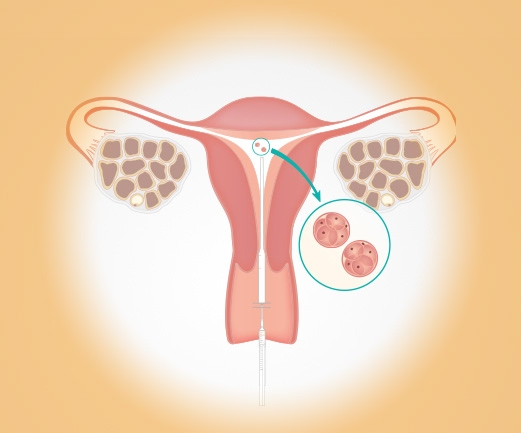
At Kinderwunschzentrum Dresden, we emphasize that a diagnosis of "not permeable" is not a final verdict. Through specialized treatments like IVF, we can bypass the fallopian tubes entirely, bringing the egg and sperm together in a controlled laboratory environment before placing the embryo directly into the uterus.
Getting pregnant with one fallopian tube: Success and chances
For many women, having only one tube (e.g., after an ectopic pregnancy or surgery) is a significant concern. However, natural pregnancy is still common with one healthy fallopian tube.
If the remaining tube is fully functional and healthy, the body often compensates. Interestingly, the healthy tube can sometimes even "pick up" an egg from the opposite ovary. While the statistical chance per cycle might be slightly lower than with two healthy tubes, the cumulative success rate over several months remains highly favourable.
Diagnosing tubal patency at Kinderwunschzentrum Dresden
Before deciding on a treatment, we must determine the status of the tubes. We utilize several diagnostic methods to check if the fallopian tubes are blocked or open:
- HyCoSy (Hysterosalpingo-Contrast-Sonography): A gentle ultrasound-based procedure using a contrast agent to visualize the flow through the tubes.
- Laparoscopy (keyhole surgery): A minimally invasive surgical procedure where a blue dye is injected into the uterus to see if it exits the tubes. This is considered the "gold standard" for diagnosing tubal adhesions, with the option to treat adhesions surgically during the same procedure.
- Hysteroscopy: Used to assess the areas where the fallopian tubes enter the uterus.
IVF and blocked fallopian tubes: The gold standard for success
When both fallopian tubes are blocked or damaged beyond repair, In Vitro Fertilization (IVF) is the most effective treatment. In fact, IVF was originally developed specifically for women with tubal factor infertility.
The success rates of IVF for blocked fallopian tubes are among the highest in reproductive medicine. Since the tubes are bypassed entirely, their condition—whether scarred, blocked, or even removed—does not negatively affect the chance of the embryo implanting in the uterus.
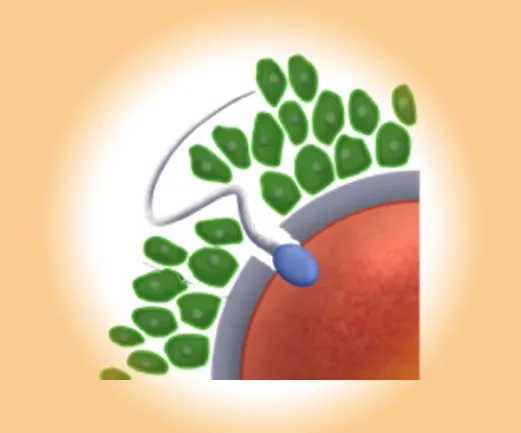
At Kinderwunschzentrum Dresden, we use personalized hormonal stimulation protocols, then the eggs are retrieved directly from the ovaries. Fertilisation takes place outside the body, and the resulting embryo is then transferred directly into the uterus.
Surgical options: Can blocked fallopian tubes be opened?
In some specific cases, surgery to "unblock" the tubes (tuboplasty) may be considered. This is most common when the blockage is minor or located at the very end of the tube.
However, it is important to be realistic about the success rates. Even if a tube is surgically reopened, the delicate internal cilia (tiny hairs) that transport the egg may have been damaged by the initial process. This increases the risk of an ectopic pregnancy.
For many patients at Kinderwunschzentrum Dresden, moving directly to IVF is often the safer and more efficient path to a successful pregnancy, as it avoids the risks and recovery time associated with tubal surgery.
Emotional support: Dealing with the diagnosis
Discovering that your fallopian tubes are blocked can feel like a physical betrayal by your own body. It is normal to feel grief, frustration, or a sense of urgency.
At Kinderwunschzentrum Dresden, we don't just treat the physical causes; we care for the people behind the diagnosis. We encourage an open dialogue about the emotional challenges of infertility. Knowing that there is a clear medical solution like IVF can often provide the mental relief needed to move forward with confidence.
FAQ – Frequently Asked Questions about Blocked Fallopian Tubes
Can I get pregnant naturally if one tube is blocked?
Yes, it is definitely possible. If your second fallopian tube is healthy, you can conceive naturally. However, if the remaining tube is also damaged or if there are other fertility factors involved, we may recommend supportive treatments.
What are the success rates of IVF with blocked fallopian tubes?
Success rates with IVF are based on the general outcomes reported by the German IVF Register (DIR). Depending on the woman’s age, the chance of achieving pregnancy per embryo transfer ranges between 25% and 45%.
In many cases, patients with an isolated tubal factor even have a slightly above-average prognosis, as there are no hormonal or genetic conditions that might interfere with implantation.
Does a blockage cause pain?
Usually, no. Most women with blocked fallopian tubes have no symptoms at all. The blockage is often only discovered when a pregnancy does not occur. Exceptions are cases caused by active endometriosis or acute pelvic inflammatory disease, which can be painful.
Can chlamydia cause blocked fallopian tubes?
Yes, chlamydia is one of the leading causes of tubal infertility. Even if the infection was years ago and had no symptoms, it can leave behind "silent" scars and adhesions that block the tubes.
Can I get pregnant if both tubes are blocked?
Yes, absolutely—but only through IVF. If both tubes are blocked, the bridge between the ovary and uterus is gone. However, your ovaries still produce eggs, and your uterus can still carry a baby. IVF performs the "bridge" function in the lab.
Can blocked fallopian tubes be opened with home remedies or massage?
There is no scientific evidence that home remedies, special teas, or massage techniques can resolve a mechanical blockage of the fallopian tubes. If you are trying to conceive, medical evaluation is essential.
Does health insurance cover IVF in cases of blocked fallopian tubes?
When infertility due to a tubal factor is medically confirmed, German statutory health insurance may cover 50% or more of IVF costs under certain conditions (such as age and marital status).
Private insurance companies often provide full coverage when there is clear medical necessity.
Do blocked fallopian tubes increase the risk of ectopic pregnancy?
Yes. If the fallopian tubes are only partially open, fertilisation may occur, but the fertilised egg can become trapped in the tube instead of reaching the uterus, increasing the risk of an ectopic pregnancy.
Is Intrauterine Insemination (IUI) possible with blocked fallopian tubes?
No. In cases where both fallopian tubes are blocked, IUI is not effective, as the sperm cannot reach the egg. In this situation, IVF is the treatment of choice.
Your path to clarity: Consult the experts at Kinderwunschzentrum Dresden
The diagnosis of blocked fallopian tubes is a challenge, but it is one we can solve together. At Kinderwunschzentrum Dresden, we offer the most advanced diagnostics and personalized IVF treatments to help you overcome tubal factor infertility.
Every journey is unique, and we are committed to finding the most effective and gentle path for you. From your first consultation to the moment you hold your child, we are by your side.
Book your consultation now – easily and confidentially via Doctolib.
Dresden Fertility Center
in the Wöhrl Plaza
Prager Str. 8a
01069 Dresden
Phone +49 351 501 400-0
Fax +49 351 501 400-28
Email:
Instagram Arrange your first appointment NEW: Video consultation! Downloads Impressions

Cryobank in the Kinderwunschzentrum Dresden
Prager Str. 8a
01069 Dresden
Tel. +49 351 50140019
E-Mail:
| Office hours | |
|---|---|
| Mon., Wed., Thu. | 08.00 – 19.00 Hrs |
| Tue. | 08.00 – 13.00 Hrs and 14.30 – 19.00 Hrs |
| Fri. | 08.00 – 14.00 Hrs |
Availability by telephone |
|
| Mon., Wed. | 08.00 – 13.00 Hrs and 14.30 – 18.00 Hrs |
| Tue., Thu., Fri. | 08.00 – 13.00 Hrs |
Blood sampling |
|
| Mon. - Thu. | 08.00 – 17.30 Hrs |
| Fri. | 08.00 – 13.30 Hrs |
On Tuesdays the clinic is closed from 13.00 to 14.30 Hrs! |
|






Service at the Fertility Center Dresden

To the planned child