


Insemination
A gentle start in fertility treatment – process, chances, and costs of insemination at Kinderwunschzentrum Dresden
Insemination, also called intrauterine insemination (IUI), is one of the most common and least invasive fertility treatments. It offers individuals and families with fertility challenges an opportunity to increase their chances of pregnancy without major medical interventions. At Kinderwunschzentrum Dresden, we combine medical expertise with empathetic support to make this first step toward parenthood as safe and comfortable as possible.
What is insemination?
Definition
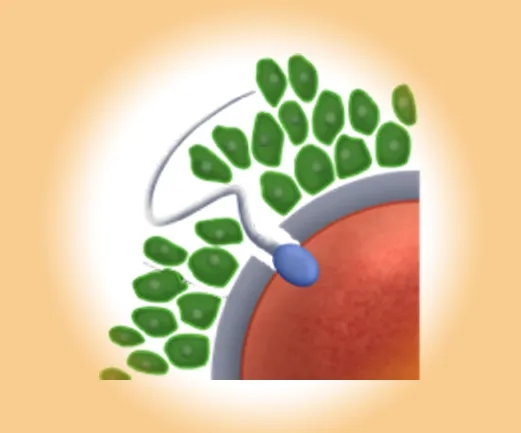
During insemination, specially prepared sperm are placed directly into the uterus, bringing them closer to the egg and increasing the likelihood of fertilisation.
Types of insemination
- Homologous insemination: using sperm from the partner.
- Heterologous insemination: Donor sperm can be used when no viable sperm from the partner is available, in same-sex partnerships, or when a woman wishes to become a single mother. Our compassionate team provides sensitive guidance and support throughout every step of the process, ensuring that each individual or couple feels respected, informed, and cared for.
The insemination process
Preparation
- Cycle monitoring and ultrasound examinations
- Hormonal stimulation may be used to support egg development
- Determining the optimal timing of ovulation
Procedure
- Sperm collection and laboratory preparation
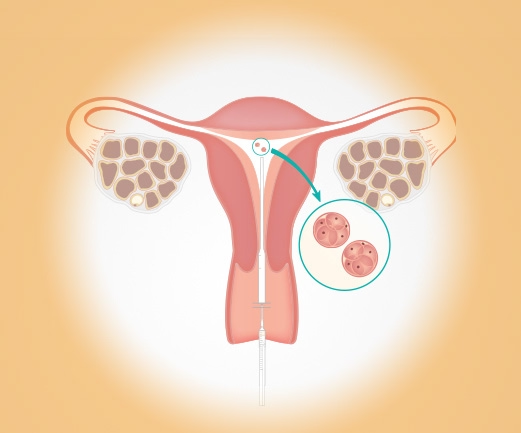
- Introduction of sperm into the uterus with a thin catheter (a soft, flexible tube)
- Painless outpatient procedure, no anesthesia required
After treatment
- Pregnancy test after about two weeks
Chances and success rates of insemination
Success rates per attempt
Chances depend on age, diagnosis, and individual conditions:
- Under 35 years: 10–15% per cycle
- Age 35–39: 7–10% per cycle
- Over 40 years: 3–5% per cycle
When is insemination useful?
- Mildly reduced sperm quality
- Unexplained infertility
- Mild endometriosis
- Family building in same-Sex partnerships
- Single motherhood by choice
Insemination costs
What does insemination cost?
Costs per cycle generally around 300 euros, depending on medication and diagnostic requirements.
Health insurance coverage
- German statutory health insurance usually covers 50% of costs for up to eight cycles under specific conditions (e.g., age, marital status).
- Private insurers may cover more, depending on the contract.
Benefits and limitations of insemination
- Advantages: low physical stress, lower costs, straightforward process
- Limitations: lower success rates compared to IVF or ICSI
- Risks: overall minimal. There is a slight chance of multiple pregnancy if hormonal stimulation is used
Homologous vs. heterologous insemination
- Homologous insemination: emotionally easier for many couples since partner’s sperm is used.
- Heterologous insemination: often the best option in cases of severe male infertility or genetic risk. A suitable treatment for those pursuing family building in same-sex partnerships or single motherhood.
At Kinderwunschzentrum Dresden, both approaches are performed with the highest medical standards and individual care.
Statistics and medical data
- According to the German IVF Registry (DIR), more than 30,000 insemination cycles are performed annually.
- Average pregnancy rates per cycle: 10–12%.
- Cumulative success increases significantly with multiple attempts.
FAQ – Common questions about insemination
How does insemination work?
Sperm are prepared in the lab and introduced into the uterus using a thin catheter (a soft, flexible tube). The procedure is painless and takes only a few minutes.
What does insemination cost?
Usually around 300 euros per cycle. German statutory health insurance often covers 50% for up to eight attempts.
What are the chances of success with insemination?
Success rates are 10–15% per cycle for women under 35, and decrease with age.
What is the difference between homologous and heterologous insemination?
Homologous insemination uses partner sperm, while heterologous insemination uses donor sperm.
How many insemination cycles are recommended?
Usually 2-3 attempts are considered before moving on to IVF or ICSI.
Take the next step toward your family goal
Insemination is a gentle and effective first step on the way to parenthood. At Kinderwunschzentrum Dresden, you are supported with experience, empathy, and advanced medical care.
Book your consultation now – discreetly and conveniently via Doctolib.
Dresden Fertility Center
in the Wöhrl Plaza
Prager Str. 8a
01069 Dresden
Phone +49 351 501 400-0
Fax +49 351 501 400-28
Email:
Instagram Arrange your first appointment NEW: Video consultation! Downloads Impressions

Cryobank in the Kinderwunschzentrum Dresden
Prager Str. 8a
01069 Dresden
Tel. +49 351 50140019
E-Mail:
| Office hours | |
|---|---|
| Mon., Wed., Thu. | 08.00 – 19.00 Hrs |
| Tue. | 08.00 – 13.00 Hrs and 14.30 – 19.00 Hrs |
| Fri. | 08.00 – 14.00 Hrs |
Availability by telephone |
|
| Mon., Wed. | 08.00 – 13.00 Hrs and 14.30 – 18.00 Hrs |
| Tue., Thu., Fri. | 08.00 – 13.00 Hrs |
Blood sampling |
|
| Mon. - Thu. | 08.00 – 17.30 Hrs |
| Fri. | 08.00 – 13.30 Hrs |
On Tuesdays the clinic is closed from 13.00 to 14.30 Hrs! |
|






Service at the Fertility Center Dresden

To the planned child