


Assisted Hatching – Procedure, Benefits and Success Rates at Kinderwunschzentrum Dresden
A supportive and evidence-based approach to improve embryo implantation potential
For many individuals and couples experiencing fertility challenges, every detail of the treatment journey carries profound emotional weight. Assisted hatching is an advanced laboratory technique used in selected IVF or ICSI treatments to potentially enhance implantation chances. While not suitable for everyone, assisted hatching may support embryo development in specific medical situations.
This explains what assisted hatching is, how the procedure works, in which cases it may be meaningful, what scientific data suggests, and how Kinderwunschzentrum Dresden integrates it into personalised fertility care.
What Is Assisted Hatching?
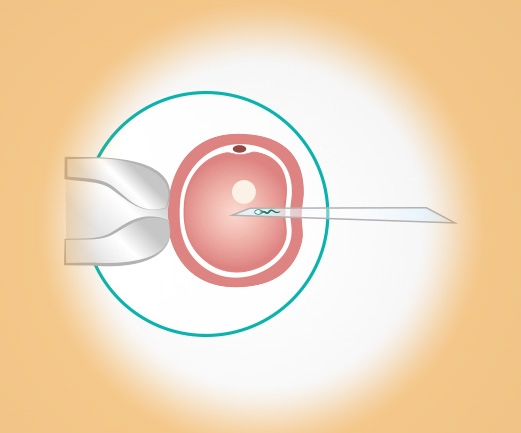
Assisted hatching is a laboratory procedure in which a tiny opening is created in the zona pellucida, the protective shell surrounding the embryo. This opening may help the embryo “hatch” more easily before implantation into the uterine lining.
Why Hatching Matters
Before an embryo can implant, it must naturally break through the zona pellucida. In some cases, this process may be impaired due to:
- Age-related changes in egg quality
- Thickening of the zona pellucida
- Laboratory freezing and thawing processes
Assisted hatching aims to support this crucial step.
How Does Assisted Hatching Work?
Assisted hatching is performed by embryologists during IVF or ICSI cycles.
Step-by-Step Procedure
- Embryo selection
Embryos that meet specific developmental criteria are chosen. - Micromanipulation
Using a microscope and microneedle or laser, a small opening is created in the zona pellucida. - Controlled precision
The opening is just large enough to facilitate the embryo’s natural hatching process without compromising structural integrity. - Embryo transfer
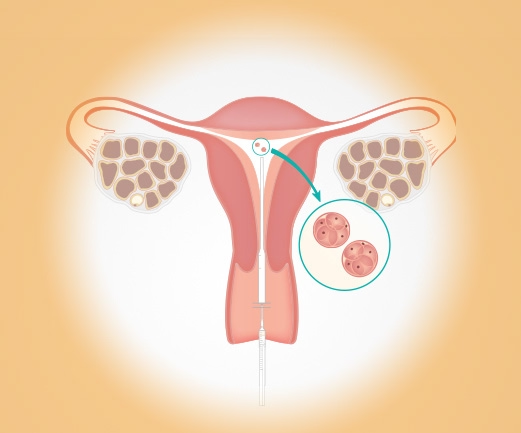
The embryo is transferred into the uterus shortly after the procedure.
Techniques Used
The widely accepted method today is laser-assisted hatching, which provides:
- High precision
- Minimal embryo handling
- Low thermal impact
- Greater reproducibility compared to mechanical techniques
Kinderwunschzentrum Dresden uses state-of-the-art laser technology to optimise safety and consistency.
When Can Assisted Hatching Be Beneficial?
Assisted hatching is not routinely recommended for all IVF patients. Evidence suggests benefits in selected medical situations.
Assisted Hatching for Women Over 37
As reproductive age increases, changes in egg quality may lead to a thickened zona pellucida. Assisted hatching may support implantation in such cases.
Repeated Implantation Failure
For individuals who have undergone several unsuccessful IVF or ICSI cycles, assisted hatching may offer an additional option to support embryo development and attachment.
Frozen-Thawed Embryos
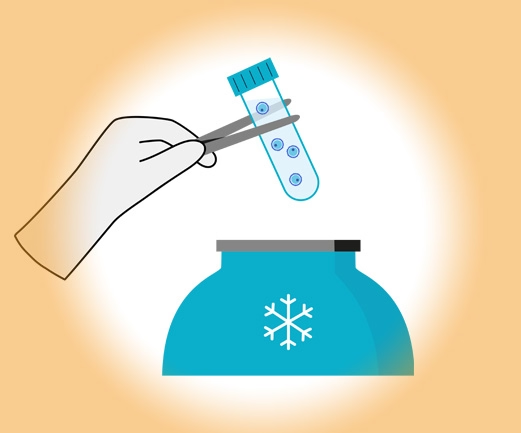
Cryopreservation can sometimes subtly alter the properties of the zona pellucida. Assisted hatching may help overcome these changes for embryos after freezing and thawing.
Embryos With Specific Morphological Characteristics
If the embryo’s zona appears unusually thick or rigid during microscopic assessment, the embryology team may recommend assisted hatching to support the hatching phase.
Benefits and Limitations of Assisted Hatching
The decision to use assisted hatching depends on individual medical factors. A balanced, evidence-based evaluation is essential.
Potential Benefits
- May support implantation in selected patient groups
- Helpful for frozen-thawed embryos
- Provides an additional option after failed IVF cycles
- High precision and minimal risk with modern laser techniques
Limitations and Considerations
- Assisted hatching does not guarantee pregnancy
- Evidence on universal effectiveness is mixed
- Not recommended for all embryos
- Slightly increased risk of monozygotic twinning in some studies
Kinderwunschzentrum Dresden ensures transparency regarding advantages and limitations so that patients can make informed decisions.
What Does Scientific Evidence Say?
Current Research and Statistics
Data from reproductive medicine studies and European IVF registries show:
- Assisted hatching may increase implantation rates in specific subgroups, especially women over 37 or patients with repeated implantation failure.
- For patients with good-quality embryos, the benefit appears limited.
- Pregnancy rates with assisted hatching vary depending on individual conditions rather than the procedure alone.
The DIR Yearbook (German IVF Registry) does not analyse assisted hatching specifically.
Assisted hatching is therefore used as a targeted measure, not a general improvement technique.
Is Assisted Hatching Meaningful for Your IVF Journey?
Assisted hatching may be considered particularly meaningful when:
- You are 37 or older
- You experienced multiple unsuccessful IVF cycles
- You use frozen-thawed embryos
- The zona pellucida appears thick or rigid
- Medical evaluation suggests reduced hatching potential
A personalised recommendation is always made based on medical diagnostics and individual treatment history.
Costs of Assisted Hatching
How Much Does Assisted Hatching Cost?
The costs depend on the technique used and the individual medical indication. Typically, they range between:
- 200–300 euros per cycle (self-paid treatment)
Does Insurance Cover Assisted Hatching?
As a rule, health insurance companies do not cover these costs, as the benefit is not guaranteed in all cases.
At the Kinderwunschzentrum Dresden, all costs are discussed openly and transparently with you before treatment begins, so you know exactly what to expect.
Assisted Hatching Success Rates
Realistic Expectations
Success rates depend primarily on:
- Female age
- Embryo quality
- Uterine and hormonal environment
- Underlying fertility conditions
When assisted hatching is used in medically appropriate situations, some studies show a moderate increase in implantation rates. However, success cannot be attributed solely to the procedure.
Emotional Dimensions of Assisted Hatching
Fertility treatment involves emotional complexity. Many patients experience hope, uncertainty and anticipation when evaluating additional treatment options. Kinderwunschklinik Dresden supports patients through:
- Clear, respectful communication
- Psychological support services
- Transparent discussion of expected outcomes
- Empathy for the emotional burden of infertility
You are never alone in your journey — support and guidance are available at every step.
FAQ – Common Questions About Assisted Hatching
Does assisted hatching improve IVF success rates?
For selected patient groups, assisted hatching may increase implantation chances. It is not universally beneficial and depends on individual medical factors.
Is assisted hatching safe?
Laser-assisted hatching is considered safe when performed by experienced embryologists. Risks are minimal but may include a slightly increased chance of monozygotic twins.
How is assisted hatching performed?
A small opening is created in the embryo’s outer shell using a precision laser before embryo transfer.
When is assisted hatching recommended?
Common indications include age over 37, repeated implantation failure, frozen-thawed embryos or specific embryo characteristics.
How much does assisted hatching cost?
Costs vary based on individual treatment plans. They typically range from 200 to 300 euros per cycle. A detailed overview is provided during consultation.
Assisted hatching can be a meaningful addition to your personalised fertility plan. The specialists at Kinderwunschzentrum Dresden combine medical expertise with compassionate care to help you make informed, confident decisions.
Book your confidential consultation now via Doctolib – supportive, respectful and tailored to your needs.
Dresden Fertility Center
in the Wöhrl Plaza
Prager Str. 8a
01069 Dresden
Phone +49 351 501 400-0
Fax +49 351 501 400-28
Email:
Instagram Arrange your first appointment NEW: Video consultation! Downloads Impressions

Cryobank in the Kinderwunschzentrum Dresden
Prager Str. 8a
01069 Dresden
Tel. +49 351 50140019
E-Mail:
| Office hours | |
|---|---|
| Mon., Wed., Thu. | 08.00 – 19.00 Hrs |
| Tue. | 08.00 – 13.00 Hrs and 14.30 – 19.00 Hrs |
| Fri. | 08.00 – 14.00 Hrs |
Availability by telephone |
|
| Mon., Wed. | 08.00 – 13.00 Hrs and 14.30 – 18.00 Hrs |
| Tue., Thu., Fri. | 08.00 – 13.00 Hrs |
Blood sampling |
|
| Mon. - Thu. | 08.00 – 17.30 Hrs |
| Fri. | 08.00 – 13.30 Hrs |
On Tuesdays the clinic is closed from 13.00 to 14.30 Hrs! |
|






Service at the Fertility Center Dresden

To the planned child