


Undescended Testicles and Fertility – What It Means for Male Reproductive Health
Evidence-based fertility counselling with empathy and clarity at Kinderwunschzentrum Dresden
An unfulfilled wish to have a child often leads couples to search for answers in unexpected places. For some men, a condition that occurred in early childhood—undescended testicles—may play a role years later when starting a family. Many affected men ask themselves: Can I still be fertile? Does unilateral undescended testicle affect fertility? What is the real risk of infertility?
This guide explains how undescended testicles influence fertility, what the scientific data show, whether fatherhood is still possible, and how Kinderwunschzentrum Dresden supports couples with medical expertise, transparency and compassion.
What Are Undescended Testicles?
Undescended testicles, medically known as cryptorchidism, describe a condition in which one or both testicles do not descend into the scrotum before birth or shortly thereafter. Instead, the testicle may remain in the abdomen or inguinal canal.
How Common Is Cryptorchidism?
Undescended testicles occur in:
- Around 3–5% of full-term male newborns
- Up to 30% of premature male infants
- About 7% of cases are bilateral
In most cases, spontaneous descent occurs within the first months of life. If not, surgical correction is usually recommended in early childhood.
Why Do Undescended Testicles Affect Fertility?
Temperature and Sperm Production
The scrotum provides a cooler environment than the abdominal cavity. Normal sperm production requires a temperature of around 34 °C.
Higher temperatures, such as those found in the abdomen or inguinal canal, can over time lead to:
- Reduced sperm count
- Decreased sperm motility
- Abnormal sperm morphology
- Reduced testicular function
- Long-term structural changes in testicular tissue
The duration and extent of exposure to higher temperatures play a crucial role. The earlier an undescended testicle is corrected, the better the prognosis for future fertility.
Unilateral Undescended Testicle and Fertility
Can Fertility Be Preserved With One Affected Testicle?
Many men have unilateral cryptorchidism, meaning only one testicle was undescended.
Clinical data show:
- Fertility is often preserved if the other testicle developed normally
- Sperm parameters may still be reduced compared to men without cryptorchidism
- Natural conception is frequently possible
Studies show that most men with unilateral cryptorchidism are still fertile — often even without medical assistance.
Bilateral Undescended Testicles and Fertility
Higher Risk of Reduced Fertility
When both testicles are affected, the risk of impaired fertility increases significantly.
Possible consequences include:
- Reduced sperm count
- Impaired sperm motility
- Abnormal sperm morphology
However, reduced fertility does not automatically mean infertility. Even men with bilateral cryptorchidism can become fathers — either spontaneously or with the support of modern reproductive medicine.
Can You Be Fertile Despite Undescended Testicles?
Fertile Despite Cryptorchidism – Is It Possible?
Yes. Many men with a history of undescended testicles are fertile and father children naturally.
Fertility potential depends on:
- Whether one or both testicles were affected
- Timing of surgical correction
- Presence of residual testicular function
- Overall reproductive health
The diagnosis alone does not determine reproductive outcome.
Does Early Surgery Improve Fertility Outcomes?
Importance of Early Orchidopexy
Surgical correction (orchidopexy) is usually recommended between 6 and 12 months of age.
Evidence suggests:
- Early surgery improves later sperm production
- Delayed correction increases infertility risk
- Testicular tissue preservation is better with early intervention
Despite early surgery, some men may still experience reduced sperm quality in adulthood.
Risk of Infertility With Undescended Testicles
What Do the Statistics Show?
The likelihood of infertility depends on several factors:
- Unilateral vs. bilateral involvement
- Position of the testicle
- Timing of surgical correction
- Functional capacity of the remaining testicular tissue
Medical guidance
- Unilateral undescended testicle: very good chances, often normal fertility
- Bilateral undescended testicles after correction: around 40–60% have reduced semen parameters
- Very late surgical correction: higher risk of fertility impairment
- Early correction: near-normal fertility is often possible
Important to know:
Even if a semen analysis shows abnormalities, modern treatments such as ICSI can still make fatherhood possible.
Diagnostic Evaluation of Fertility in Men With Cryptorchidism
A comprehensive diagnostic evaluation includes:
- Semen analysis (at least two tests at different time points)
- Hormone levels (FSH, LH, testosterone)
- Ultrasound examination of the testicles
- Genetic testing
- Urological follow-up, as there is a slightly increased risk of testicular tumors
This diagnostic approach allows for a thorough and individualized assessment of actual fertility potential.
Fertility Treatment Options for Men With Undescended Testicles
Natural Conception
If semen parameters are within acceptable ranges, natural conception may still be possible.
Assisted Reproductive Techniques
Depending on sperm quality, options may include:
- Intrauterine insemination (IUI)
- IVF (In vitro fertilization)
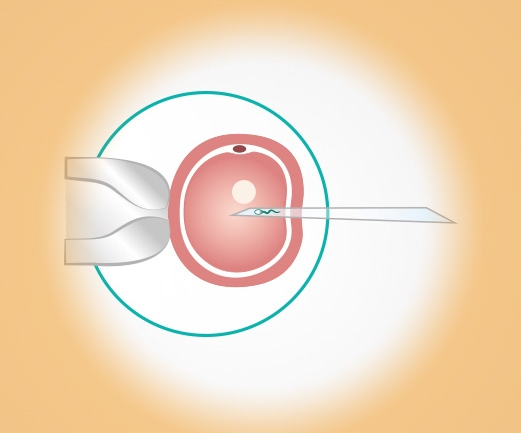
- ICSI (Intracytoplasmic Sperm Injection)
Surgical Sperm Retrieval (TESE)
In cases of severe sperm impairment or azoospermia, surgical sperm retrieval techniques such as TESE may be considered.
Hormonal evaluation or treatment
In cases of hormonal disorders, treatment may help improve sperm production.
Data from the German IVF Registry (DIR Yearbook) show that couples with reduced male fertility often still have good chances of success — especially with ICSI.
Emotional Aspects of Fertility Concerns in Men
Learning that a childhood condition may affect fertility can be emotionally challenging. Men often experience:
- Feelings of guilt or inadequacy
- Anxiety about masculinity or fatherhood
- Reluctance to discuss fertility issues
These feelings are completely understandable. At the same time, medical knowledge can be reassuring and empowering. Kinderwunschzentrum Dresden addresses male fertility concerns with respect, discretion and empathy.
When to Seek Fertility Evaluation
Fertility assessment is recommended if:
- Pregnancy does not occur 6 to 12 month of regular, unprotected intercourse
- There is a known history of undescended testicles
- Semen analysis has not yet been performed
- Reassurance or clarity is desired
Early evaluation allows timely planning.
FAQ – Common Questions About Undescended Testicles and Fertility
Can a man be fertile despite undescended testicles?
Yes. Many men, especially with unilateral cryptorchidism, are fertile.
Does unilateral undescended testicle affect fertility?
It may reduce fertility potential slightly, but natural conception is often possible.
What is the infertility risk with undescended testicles?
It depends on whether one or both testicles are affected, the timing of correction, and individual factors. Unilateral cases usually have good chances, while bilateral cases carry a higher risk — but infertility is not inevitable.
Does childhood surgery eliminate infertility risk?
Early surgery improves outcomes but does not completely eliminate fertility risks.
What fertility treatments are available if sperm quality is reduced?
Options include IUI, IVF, ICSI or surgical sperm retrieval (TESE), depending on findings.
How can I find out if I am fertile?
A semen analysis provides reliable information about male fertility. The examination is straightforward and can be completed quickly.
How does Kinderwunschzentrum Dresden support patients with undescended testicles?
Support includes diagnostic evaluation, semen analyses, individualized reproductive treatment planning, and ICSI/TESE treatments, all tailored to the individual situation.
Is there an increased risk of testicular cancer?
Yes, there is a slightly increased risk. For this reason, urologists recommend regular check-ups.
Take control of your fertility – we are here to support you
A history of undescended testicles does not mean that fatherhood is out of reach. With evidence-based diagnostics, personalised treatment strategies and empathetic care, Kinderwunschzentrum Dresden supports couples in understanding their fertility and exploring realistic options.
Schedule your confidential consultation now via Doctolib – professional, respectful and individually tailored.
Dresden Fertility Center
in the Wöhrl Plaza
Prager Str. 8a
01069 Dresden
Phone +49 351 501 400-0
Fax +49 351 501 400-28
Email:
Instagram Arrange your first appointment NEW: Video consultation! Downloads Impressions

Cryobank in the Kinderwunschzentrum Dresden
Prager Str. 8a
01069 Dresden
Tel. +49 351 50140019
E-Mail:
| Office hours | |
|---|---|
| Mon., Wed., Thu. | 08.00 – 19.00 Hrs |
| Tue. | 08.00 – 13.00 Hrs and 14.30 – 19.00 Hrs |
| Fri. | 08.00 – 14.00 Hrs |
Availability by telephone |
|
| Mon., Wed. | 08.00 – 13.00 Hrs and 14.30 – 18.00 Hrs |
| Tue., Thu., Fri. | 08.00 – 13.00 Hrs |
Blood sampling |
|
| Mon. - Thu. | 08.00 – 17.30 Hrs |
| Fri. | 08.00 – 13.30 Hrs |
On Tuesdays the clinic is closed from 13.00 to 14.30 Hrs! |
|






Service at the Fertility Center Dresden

To the planned child